Showing posts with label Faith. Show all posts

2.05.2013

OMg

Calvin and Hobbes - Bill Watterson

*Maybe I should be depressed about this, but while I am not eagerly awaiting my death, I know everything has its time.  I am going through a religious questioning phase right now about the existence and role of a  theistic being.  In other words - do I believe in a God with a big G or not?   For now, I am starting to feel or believe that there is a cosmic greatness out there, but that my existence influences or is known by that great being is about the same as my influence on that ant hill in the yard at my parent's place a thousand miles away.  My universe is too big to know of every life form I have some connection to and potential power over.  Those ants walk their little bits of food and building pieces to their hill and I never know of their existence and will not know of their deaths.

This is how I am seeing the great cosmic force that is out there.  This greater entity, whether it is powers of nature and science regulating everything, a spiritual being, or the combined energy of all life and forces in the universe, shapes our entire origin, life, demise and whatever is next.  It is much like me starting my truck.  I installed the engine, hooked up the fuel, and turned the key.  The engine starts and I drive away.  Even though I am cognizant of the crank shaft pushing the pistons up and down, I am not in control of or care about each rotation in the engine as it spins at 3000 rpm.  It is going on its own.  Along my trip, I may drive over a pebble that spits out into field and later is used to become part of a groundhog's nest.  All of this action is set into motion because I put the engine into my truck.  Am I cognizant of each of these interactions?  No.   It is just the whole system running on what I have done.

I am that little pebble thrown out into field.  God, the entity, the forces of nature, or whatever  don't care about that pebble or don't even know its existence.  This moment of me is just one of the smallest parts of the countless interactions and beings in the universe moving along its own path.

Part of this realization came from looking at the faith I learned along the way.  I looked at all the death, catastrophes (natural or man made) and wondered why an "all loving being" could do that, or at least, prevent them?  Why would an omnipotent being care about such petty things and how it is worshiped?  How could a knowing and loving entity allow different religions to kill in its name?   For me, why would a supreme being care about gender, politics, or different religions, race, sexual orientation, etc.? Is the answer truly "42"?


Some of y potential (but not all-inclusive) answers are:
A.  It acts like a kid having temper tantrums, not knowing the damage it does.
B.  It is something that goes beyond war crimes, genocide, and any crimes of humanity or nature we can understand and makes Hitler, Stalin, and their ilk (speaking of which, why would a deity allow these people to become what they were in first place?), look like doves. (Take the Noah story - why kill every human and animal on the earth, except those chosen few, just to make a point.  That alone is an atrocity that goes beyond anything witnessed in history.  I am sure that at least a few of the humans wiped out in this moment of wrath were good people that were just unfortunate enough to be in the wrong place.   I wont even go into the horrors in the book of Job.  
C. It is something that set the whole engine in the universe going and lets things play out by the rules of nature, science, and free will of the mind.  

Maybe it is time for me to realize I am just that speck that Calvin alludes to.  This is not depressing, it is freeing.  I am released from this burden of the exceptionalism of organized religion where each faith knows it is right and all others are wrong.  I get to do what I do, help others, try not to hurt, maybe create a little beauty, make things better and then snuff out and become part of the great cosmos again.

George Carlin summed it all up so well.
See I don’t worry about the little things: bees, trees, whales, snails. I think we’re part of a greater wisdom than we will ever understand. A higher order. Call it what you want. Know what I call it? The Big Electron. The Big Electron…whoooa. Whoooa. Whoooa. It doesn’t punish, it doesn’t reward, it doesn’t judge at all. It just is. And so are we. For a little while.
*I am not criticizing anyone's beliefs.  I am criticizing my own path and analyzing my own journey and what I am slowly learning.  I am not saying what I am sharing is the answer to it all.  No one knows that for certain, but maybe only what is certain to them. 

I promise nudes and shallowness, levity, and other things in my next post.


9.02.2012

The "big" of it all

Time (featuring Gabbi)* - 090212
I want to focus on the big picture as a conclusion to my series of posts on time.  It is easy to focus on the now, the world within a few feet of me, and the people I can see around me.  Even though I have a well established sense of object permanence, I still tend to disregard the big world around me that I am not immediately interacting with. 

My mind knows that my wife is at a church a few blocks away.  I know that my parents are probably getting in the car for their trip to their church.  I am sure President Obama and Governor Romney are talking about the election to some other people.  Even though I know all this stuff, I am not really thinking about it. 

Right now I am looking out at grassy area on the UC Berkeley Campus, drinking a tea (trying to soothe a sick stomach) and writing this.  A wall is behind me, a number of men are sitting in a random pattern in tables facing away from me.  My whole world can easily be summed up by what I am seeing, hearing, feeling, smelling and tasting at this moment.  This sense of "immediate-me" creeps into all my senses, including one of the senses we don't really count as a sense - the sense of time. 

When I was getting my first undergraduate degree**, I took two influential courses in the same quarter, geology and and astronomy.  It was in both of those classes that my concept of size, space, and time were challenged.  I held a rock that was over two billion years old.  I learned I was made of dust from stars long dead.  One night, my astronomy class used a telescope and I became a speck.    We looked at  a very faint, distant object and my professor mentioned that it was a very old star and that I was looking back in time, probably a few billion years.  He then told us that star probably didn't exist anymore and if it had a solar system, all its planets were burnt up and dust.  After looking back in time, I let my eyes adjust to the dark while standing in the cold mountain air and looked at the Milky Way floating above.  I got a glimpse into how long time really is.  The enormity hit me and I had to sit down and felt tears run down my cheeks due to the magnificent grandeur of it all and how damn insignificant I really am.

Someday you will have to say "goodbye" to the sun.
You will bid farewell to the moon, the sky, the clouds, and the stars.
As all things that live, we dim out to a smoking wick, our quiet goodbyes to those things that were  always with us acknowledge we were the grain and they were the beach.
They may not hear our goodbyes, but their existence in our beings need to be recognized and bid proper adieu. 

After that moment, I felt so insignificant in the great sense of time and space.  In the universe, I am less than a grain of sand and in the dimension of time I am less than a atomic flash.   When compared to the extreme greatness of both, there is no microscope powerful enough or time piece precise enough to measure or observe my existence.  This was (and sometimes still is) a pretty depressing realization, until I learned of another truth - the order of it all.

Our universe is spread across time and space.  It isn't haphazard or random.  Invisible forces keep it in order and can help us theorize on what has happened and predict what will happen.  Stars form from the dust of other dead stars.  From that, solar systems form, life my grow on a few planets, then the star dies out, one way or another and it starts over again.  The same is for humans, we are born, we grow up, some of us procreate, and we die.  All I have to do is live in the time I have, try not to harm others, help where I can, enjoy and experience the awe of it all, and die.  In the grand scheme of things, I really don't have much to do.   The weight of the universe is not on my shoulder and I am a tiny piece of lint on its broad shoulders.


* Please click on this to see the big picture.

** I am not bragging about my number of undergrad degrees.  I pissed away my first (psychology) by not getting good enough grades by being lazy.  This laziness cost me the chance to get into grad school and finding a job.  I went back for a second degree and did much better because of the hard lessons learned from my first one.

6.24.2011

Evolution in Art

Young Spartans, 1860- Edgar Degas

“If the classical body is a representation of man’s baseness, then the evolutionary body is a return of that which has been repressed. And if the classical nude represents pure form, intellect, rationality… … then the evolutionary body figures the subject as hopelessly bound to his corporeality “ - Martha Lucy – Reading the Animal in Degas’s Young Spartans [1].

What a difference a few centuries makes in the Western art world. Up through the Baroque period, artists were experimenting with ways to portray the human form, whether lofty and noble, mortal and liminal, or debased and low down. Even with all these varied ways of showing the levels of humanity, there was usually a respectful acknowledgment, or at least nod, to the church and religion. Then along came Darwin and his The Origin of the Species positing the theory of evolution. Artists, academics, and other influential groups starting to represent scientific principles that were contrary to church dogma.

In Edgar Degas’s painting, Young Spartans, there are three groups of people. In foreground left, a group of bare breasted women tauntingly and challengingly face toward a group of men. On the right side a group of nude young men face toward the women, sizing up their potential adversaries/mates and stretching as if readying for competition or a fight. Between the two groups stand clothed characters in the background, observing the upcoming competition/courtship.

In Lucy’s article, the author proposes the characters on both sides, but especially the young males represent Degas’ intentional use of evolutionary theory to mock the historic classical artistic values honoring the perfection of the human physique. The group of men is shown in all different poses that could represent the major steps of evolution, from crawling on all fours to a limber, classical body.

While writing about this, Lucy uses multiple times the term “atavistic” which comes term “atavism”. Atavism is “tendency to revert to ancestral type.”[2] This “tendency” to show traits of our ancestors is evident in the development of the human fetus. The developing fetus will grow through stages where it has a tail, has similar structures to non-vertebrates and then lower vertebrates until it becomes a recognizable human form. The atavistic growth is evident in Degas’ rendering of the men going from ground crawlers to upright males. This willingness of purposefully including evolutionary elements into the artwork is not a subtle subversive message aimed at religion, but an obvious attack on the principles that humans are stationary beings near to perfection and modeled after God. Instead of using a religious theme to promote the propaganda of the church, Degas is potentially using his painting to promote the ideas of science and evolution. This anti-church act may have resulted in his death a century or two earlier, but must have been more acceptable as science and its disciplines were being accepted by the academic and higher levels of society and culture during this period of Degas’ art life.


1. "Reading the Animal in Degas's Young Spartans" by Martha Lucy - Nineteenth-Century Art Worldwide - a journal of nineteenth-century visual culture.

2. Altavism – Wikipedia - http://en.wikipedia.org/wiki/Atavism
 

5.17.2011

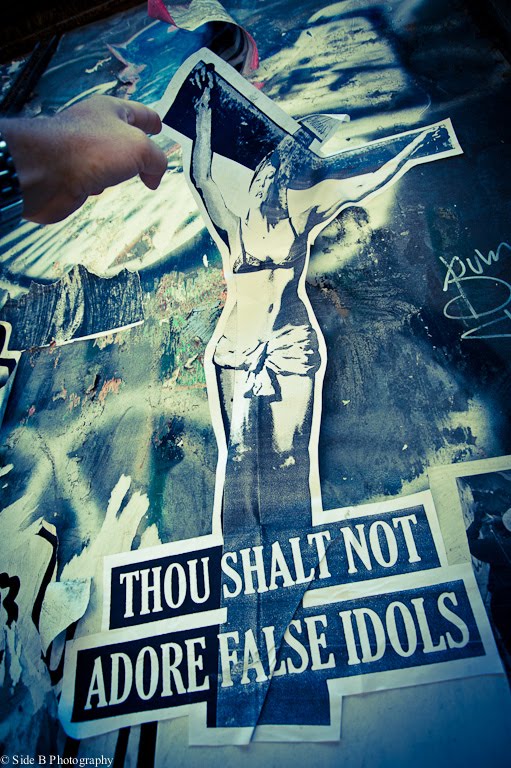
*Enlightenment vs. Dogma

SF MoMA - 102810-2
SF MoMA - 102810-2


On this date in 1553>  Michael Servetus, who discovered the pulmonary circulation of blood, is burned for heresy in Switzerland.  History Channel "This Day in History" update.

It is scary how people are still so afraid of science and what we are learning from it. I am not proclaiming against any one faith.  I wish though we could be a bit more open minded.  Maybe that is what separates the "elitists" from the others, openness to being wrong and learning more.

 For many ignorance is bliss and dogma is absolute.


(Still on break due to finals and crazy work schedules.  I hope to be writing again next week)